 Goalora
Chain Press
advanced · push_horizontal
Setup
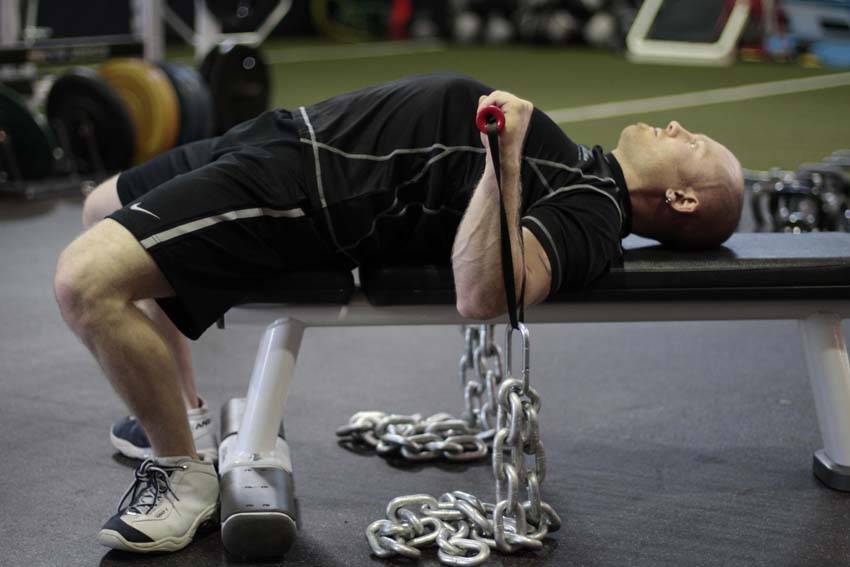
Loop a length of chain onto each end of the bar so most of the links rest on the floor when the bar is at its lowest point. Set the rack's safety pins before you lie down: about 2-3 cm below the point where the bar touches your chest, low enough not to block a full rep but high enough that flattening your back into the bench drops the bar onto the pins instead of onto your chest; check that with an empty bar before you load it. Lie back on the bench inside the rack, pull your shoulder blades back and down, and drive your feet into the floor before you unrack the bar. Dedicated lifting chains are rare at ordinary Vietnamese gyms; heavy resistance bands anchored to the base of the rack create a similar effect.
Execution
- Grip the bar wider than shoulder-width with your wrists stacked over your forearms, and unrack it without letting your shoulder position collapse.
- Inhale and lower the bar under control to your chest; as it nears the bottom more chain settles on the floor, so the load gets lighter.
- Touch your chest lightly, pause for a beat, keeping the elbows tucked close to the body the whole way.
- Exhale and drive the bar up as hard as you can; the chain lifts off the floor and adds load right where you are strongest.
- If you stall mid-press, call your spotter; with no spotter, lower the bar onto the safety pins, flatten your back into the bench so the bar rests on the pins, then slide out from under it. Never roll the bar down your body to escape while chains are hanging off both ends.
- Guide the bar back onto the rack hooks once the set is done, checking the chains have not tangled around the bench legs.
Breathing
Inhale as you lower the bar to your chest, exhale as you press it up. Do not hold your breath to move the weight; if you have high blood pressure, heart disease, a hernia or you are pregnant, never hold it at all.
Quick cues
- The chains bite hardest at your strongest point.
- Drive the floor, pin your back.
- Elbows tucked the whole press.
- A real pause before you drive.
- Always have a spotter or safety pins.
Common faults
Fault: The chains swinging into the bench or the lifter's legs mid-set
Fix: Check the chain length before starting and lay them neatly beside the bench, not hanging off to the side.
Fault: Choosing chains so heavy the bottom of the range is already near failure
Fix: Remove some links or switch to a plain bar until the full descent is under control.
Fault: The elbows flaring out on the way down to the chest
Fix: Tuck the elbows in closer, around 45-60 degrees, before starting the descent.
Fault: Loading up heavy alone with no spotter or safety pins
Fix: Set the safety pins about 2-3 cm below the point where the bar touches your chest and test them with an empty bar first, or bring a training partner to spot before attempting a new heavy load.
Equipment
barbell, bench, power_rack, other
Muscle groups
chest, arms, shoulders